

Electronic Components Market Outlook 2025–2035, Key Drivers, Market Share, Segmentation & Emerging Trends
Electronic Components Market
Electronic Components Market Size, Share and Research Report By Challenges (Supply-Chain Concentration & Geopolitical Disruption, Cyclical Inventory Corrections
The Electronic Components Market is experiencing strong growth fueled by advancements in consumer electronics, automotive electronics, IoT devices, and industrial automation technologies.”
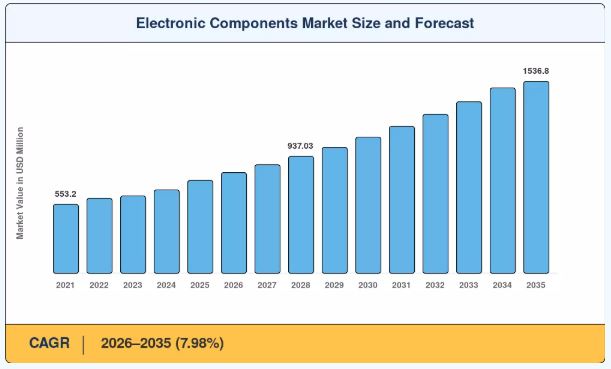
NEW YORK,, NY, UNITED STATES, June 22, 2026 /EINPresswire.com/ -- The Global electronic components market reached an estimated USD 745.06 billion in 2025 and is projected to grow from USD 804.53 billion in 2026 to USD 1,536.80 billion by 2035, registering a CAGR of 7.98% during the forecast period. — Market Research Future (MRFR)
Two major catalysts are driving this robust trajectory: the explosive proliferation of connected devices across consumer electronics, automotive, industrial automation, and telecommunications infrastructure which collectively added over 3.2 billion new networked endpoints globally between 2022 and 2024 and the accelerating transition to electrified transportation and renewable energy systems that demand unprecedented volumes of power semiconductors, capacitors, inductors, and passive components. With global electronic component shipments now surpassing 4 trillion units annually, the industry sits at the absolute foundation of the modern digital economy, enabling every device, network, vehicle, and system that defines contemporary life.
Legacy component supply chains built around extended lead times, single-source procurement, and minimal inventory buffers were exposed as structurally fragile during the 2020–2022 global semiconductor shortage, which cost the automotive industry alone an estimated USD 210 billion in lost production. In response, original equipment manufacturers (OEMs), electronics manufacturing services (EMS) providers, and component distributors are fundamentally redesigning supply chain architectures investing in multi-sourcing strategies, regional manufacturing capacity, and AI-driven demand sensing platforms.
This structural transformation is reshaping the electronic components landscape from a commodity-driven volume business into a strategic, technology-differentiated ecosystem where design-in relationships, supply chain resilience, and embedded intelligence define competitive advantage.
Get Full PDF Sample Copy of Report: (Including Full TOC, List of Tables & Figures, Chart) @
https://www.marketresearchfuture.com/sample_request/42345
➤ How Significant Is the Electronic Components Market’s Growth?
The electronic components market has demonstrated resilient and accelerating expansion, rising from approximately USD 489.7 billion in 2021 to an estimated USD 745.06 billion in 2025, reflecting a strong historical growth trajectory underpinned by surging demand across five concurrent megatrends: 5G network buildout, electric vehicle (EV) adoption, artificial intelligence hardware acceleration, industrial IoT deployment, and smart energy grid modernization.
The market is projected to add nearly USD 492 billion in incremental revenue over the next decade, with semiconductors, multilayer ceramic capacitors (MLCCs), power management ICs, and RF components representing the fastest-growing sub-segments.
The increasing electronics content per unit across virtually every product category is a structural growth driver that operates independently of macroeconomic cycles. A modern battery electric vehicle contains approximately USD 600–900 worth of passive components alone roughly four times the component content of an equivalent internal combustion engine vehicle. A 5G base station requires approximately 2.5 times the passive component count of its 4G predecessor.
A next-generation AI training server cluster consumes power management, memory interface, and signal processing components valued in the tens of thousands of dollars per rack. These content-per-unit dynamics ensure sustained volumetric demand growth regardless of near-term unit shipment fluctuations in any single end market.
➤ What Does the Future Hold for the Electronic Components Market?
Advanced packaging and heterogeneous integration stand at the forefront of the market’s next growth phase. As Moore’s Law scaling approaches fundamental physical limits, the semiconductor industry is increasingly turning to chiplet architectures, 3D stacking, and system-in-package (SiP) designs that require novel substrate materials, advanced interconnects, and precision passive components with performance specifications that push the boundaries of current manufacturing capabilities.
Leading foundries and IDMs are investing over USD 500 billion in new semiconductor fabrication capacity through 2030, creating a massive downstream demand pull for advanced packaging materials, test and measurement components, and precision interconnect solutions.
The electrification of transportation is reshaping the power electronics segment in profound ways. Wide bandgap semiconductor materials silicon carbide (SiC) and gallium nitride (GaN) are displacing traditional silicon-based power devices in EV inverters, onboard chargers, and DC-DC converters, enabling higher switching frequencies, lower switching losses, and dramatically reduced thermal management requirements.
The global SiC power device market alone is projected to exceed USD 12 billion by 2030, growing at a CAGR exceeding 25%, as automotive OEMs including Tesla, BYD, GM, and Volkswagen commit to SiC-based powertrain architectures across their next-generation EV platforms.
Artificial intelligence is simultaneously transforming both the demand side and the supply side of the electronic components market. On the demand side, AI accelerator chips GPUs, TPUs, and custom AI ASICs are driving unprecedented demand for high-bandwidth memory (HBM), advanced power delivery networks, and high-speed signal integrity components.
On the supply side, AI-driven manufacturing quality control systems, predictive maintenance platforms, and intelligent demand forecasting engines are enabling component manufacturers to reduce defect rates, optimize yield, and respond to demand signals with speed and precision previously unattainable through human-managed processes.
➤ Who Are the Key Players in the Electronic Components Market?
The electronic components landscape is characterized by a stratified mix of global semiconductor giants, specialized passive component manufacturers, power electronics leaders, and diversified electronic components distributors. Key participants shaping the competitive dynamics include:
★Taiwan Semiconductor Manufacturing Company (TSMC) the world’s largest dedicated semiconductor foundry, manufacturing advanced logic chips for Apple, NVIDIA, AMD, and virtually every leading fabless semiconductor company
★Samsung Electronics a vertically integrated semiconductor and components giant with dominant positions in DRAM, NAND flash memory, and display driver ICs, as well as a major foundry business
★Murata Manufacturing the world’s largest manufacturer of multilayer ceramic capacitors (MLCCs) and a leading supplier of RF modules, inductors, and wireless connectivity components
★TDK Corporation a global leader in passive components, magnetic materials, and energy devices, with significant positions in MLCCs, ferrite cores, and wireless charging components
★Texas Instruments the world’s largest analog semiconductor company, supplying power management ICs, operational amplifiers, data converters, and embedded processors across industrial, automotive, and communications markets
★Infineon Technologies Europe’s largest semiconductor company, with market-leading positions in automotive power semiconductors, SiC devices, microcontrollers, and security chips
★STMicroelectronics a leading supplier of automotive-grade microcontrollers, SiC power devices, MEMS sensors, and motor control ICs with strong design-in relationships across European and Asian OEM ecosystems
★Vishay Intertechnology one of the world’s largest manufacturers of discrete semiconductors and passive components including resistors, capacitors, inductors, and power MOSFETs
★Yageo Corporation a global top-three passive components manufacturer following its acquisitions of Pulse Electronics and KEMET, with broad coverage across resistors, capacitors, and inductors
★TE Connectivity a global leader in connectivity and sensor solutions, supplying connectors, relays, sensors, and circuit protection components across transportation, industrial, and communications end markets
Competition in the market is intensifying as component manufacturers race to qualify advanced materials for next-generation applications, expand manufacturing capacity in geopolitically resilient locations including India, Vietnam, Malaysia, and Mexico, and build direct design-in relationships with OEM engineering teams to secure long-term supply agreements.
Strategic M&A activity including Analog Devices’ acquisition of Maxim Integrated, Renesas’ acquisition of Dialog Semiconductor, and Infineon’s acquisition of Cypress Semiconductor continues to reshape the competitive landscape and broaden vendor product portfolios.
➤ What Are the Emerging Trends in the Electronic Components Market?
Several transformational trends are redefining how the electronic components market evolves through 2035:
Wide Bandgap Semiconductor Adoption: SiC and GaN power devices are displacing silicon across EV powertrains, fast chargers, renewable energy inverters, and industrial motor drives enabling higher efficiency, higher temperature operation, and significantly reduced system size and weight.
Advanced Packaging & Chiplet Integration: Heterogeneous integration through chiplet architectures, 2.5D/3D packaging, and fan-out wafer-level packaging is enabling unprecedented compute density and performance-per-watt, driving demand for advanced substrates, underfill materials, and micro-bump interconnects.
Supply Chain Regionalization & Geopolitical Resilience: U.S. CHIPS Act investments, EU Chips Act commitments, and India’s semiconductor incentive programs are collectively catalyzing a USD 300+ billion wave of fab construction outside Taiwan and China fundamentally reshaping global component supply chain geography.
Miniaturization & High-Density Component Design: Smartphone, wearable, and IoT device manufacturers are pushing passive component form factors to 0201 and 01005 inch sizes, requiring sub-micron manufacturing precision and driving investment in next-generation ceramic and thin-film deposition technologies.
AI-Driven Manufacturing Quality & Yield Optimization: Machine vision, predictive defect detection, and AI-powered process control systems are enabling component manufacturers to achieve six-sigma quality levels at production scales, reducing warranty costs and improving supply reliability for mission-critical applications.
Sustainable & Conflict-Free Sourcing: Growing regulatory pressure from EU RoHS, REACH, and U.S. Dodd-Frank conflict minerals reporting requirements is driving investment in alternative material development, closed-loop recycling programs, and blockchain-based supply chain traceability platforms across the electronic components industry.
Get access to the full description of the report @
https://www.marketresearchfuture.com/reports/electronic-components-market-42345
➤ How Is the Electronic Components Market Segmented?
The electronic components market report provides a comprehensive segmentation framework:
By Component Type: Semiconductors (ICs, Discrete Devices), Passive Components (Capacitors, Resistors, Inductors), Electromechanical Components
(Connectors, Relays, Switches), Printed Circuit Boards (PCBs), Sensors & Transducers
By End-Use Industry: Consumer Electronics, Automotive & Transportation, Industrial Automation, Telecommunications & Networking, Aerospace & Defense, Healthcare & Medical Devices, Energy & Power
By Sales Channel: Direct OEM Sales, Authorized Distribution, Independent Distributors, Online B2B Platforms
By Technology Node: Advanced (Below 7nm), Mature (7nm–28nm), Legacy (Above 28nm), Compound Semiconductor (SiC, GaN, GaAs)
By Organization Size: Small & Medium Enterprises (SMEs), Large Enterprises & Tier-1 OEMs
➤What Are the Regional Insights from the Electronic Components Market?
Asia-Pacific dominates the global electronic components market with approximately 58% of total market share, reflecting the region’s unrivaled concentration of semiconductor fabrication, passive component manufacturing, and electronics assembly capacity. Taiwan hosts TSMC’s most advanced fabs and a dense ecosystem of IC design, packaging, and testing companies.
South Korea is home to Samsung and SK Hynix, which together control over 70% of global DRAM and approximately 50% of NAND flash memory production. Japan’s Murata, TDK, and Taiyo Yuden collectively produce the majority of the world’s MLCCs, while China’s massive electronics manufacturing ecosystem drives enormous domestic component demand alongside growing indigenous production ambitions.
North America holds approximately 18% of global market share, anchored by the United States’ world-leading semiconductor design ecosystem home to NVIDIA, Intel, AMD, Qualcomm, Broadcom, Texas Instruments, and Analog Devices as well as a significant defense and aerospace electronics manufacturing base.
The U.S. CHIPS and Science Act’s USD 52.7 billion investment in domestic semiconductor manufacturing is catalyzing the construction of major new fabs by TSMC (Arizona), Samsung (Texas), Intel (Ohio and Arizona), and Micron (New York), which will meaningfully expand North American component production capacity through the late 2020s.
Europe commands approximately 10% of global electronic components market share, with Germany, the Netherlands, and France representing the primary production centers. The Netherlands is home to ASML, the world’s sole manufacturer of extreme ultraviolet (EUV) lithography systems the critical equipment upon which all advanced semiconductor manufacturing depends.
Germany hosts Infineon’s and Bosch’s automotive semiconductor operations, while STMicroelectronics spans France and Italy with broad analog, MEMS, and power semiconductor capabilities. The EU Chips Act’s EUR 43 billion investment framework is targeting a doubling of Europe’s global semiconductor market share to 20% by 2030.
The Rest of World segment, encompassing India, Southeast Asia, Latin America, and the Middle East & Africa, is the fastest-growing regional grouping at a projected CAGR of approximately 8.2% through 2035. India’s semiconductor mission anchored by the Tata Electronics-PSMC fab in Gujarat and the Micron assembly and test facility in Sanand is positioning the country as an emerging electronics manufacturing hub.
Vietnam, Malaysia, and Thailand are rapidly expanding their roles in semiconductor assembly, testing, and passive component manufacturing as global OEMs diversify production away from China to reduce geopolitical concentration risk.
➤➤➤ Industry Analysis Reports by Market Research Future:
Motorcycle Insurance Market-
https://www.marketresearchfuture.com/reports/motorcycle-insurance-market-10016
P2P Antennas Market-
https://www.marketresearchfuture.com/reports/p2p-antennas-market-10087
Lan Cable Market-
https://www.marketresearchfuture.com/reports/lan-cable-market-10130
Iot Chips Market-
https://www.marketresearchfuture.com/reports/iot-chips-market-10148
Ir Spectroscopy Market-
https://www.marketresearchfuture.com/reports/ir-spectroscopy-market-10426
Neuromorphic Chip Market-
https://www.marketresearchfuture.com/reports/neuromorphic-chip-market-10516
Sports Technology Market-
https://www.marketresearchfuture.com/reports/sports-technology-market-10579
Drone Camera Market-
https://www.marketresearchfuture.com/reports/drone-camera-market-10764
Industrial Sensor Market-
https://www.marketresearchfuture.com/reports/industrial-sensors-market-10776
Cnc Fiber Laser Market-
https://www.marketresearchfuture.com/reports/cnc-fiber-laser-market-10941
Sagar Kadam
Market Research Future
+ +1 628-258-0071
email us here
Visit us on social media:
LinkedIn
Facebook
X
Legal Disclaimer:
EIN Presswire provides this news content "as is" without warranty of any kind. We do not accept any responsibility or liability for the accuracy, content, images, videos, licenses, completeness, legality, or reliability of the information contained in this article. If you have any complaints or copyright issues related to this article, kindly contact the author above.
